
The success of durian farming in Sri Lanka largely depends on selecting the right planting material and suitable varieties. Poor-quality plants or incorrect spacing can reduce yield, delay fruiting, and increase long-term management costs. Therefore, choosing DOA-recommended durian varieties and following proper planting practices is essential for profitable durian cultivation Sri Lanka.
Importance of Quality Planting Material
For commercial durian farming Sri Lanka, only grafted or budded plants should be used. Seed-grown durian plants are not recommended because they:
- Take longer to bear fruits
- Produce inconsistent fruit quality
- Have unpredictable growth habits
Recommended planting material:
- Healthy, grafted durian plants
- Uniform growth with a strong central stem
- Free from pests, diseases, and physical damage
Farmers should purchase plants only from recognized nurseries approved by the Department of Agriculture (DOA) Sri Lanka to ensure quality and varietal authenticity.
DOA-Recommended Durian Varieties in Sri Lanka
The Department of Agriculture Sri Lanka recommends several locally adapted durian varieties that perform well under Sri Lankan climatic conditions.
Horana Jumbo
Horana Gold
Kasun
Gannoruwa sweet
Ambatanna
Planting Season for Durian Wagawa
The best time for durian planting in Sri Lanka is:
- Beginning of the rainy season
- When soil moisture is adequate but not waterlogged
Planting during heavy rain or dry periods should be avoided to reduce plant stress and mortality.
Spacing Requirements for Durian Plantation
Proper spacing is crucial for long-term productivity in durian plantation Sri Lanka.
Recommended spacing:
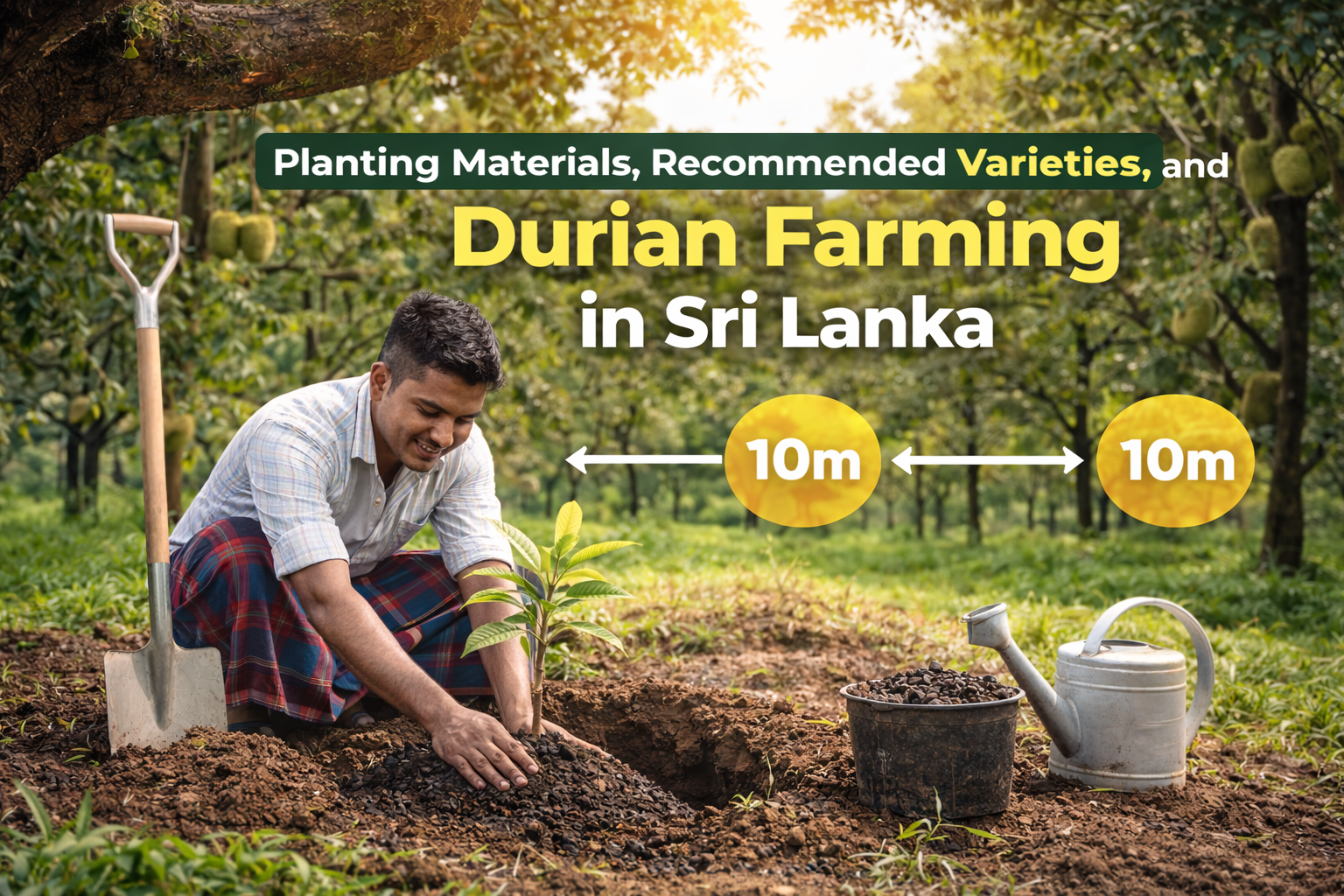
- 10 m × 10 m for high-fertility soils or large-scale farms
Correct spacing ensures:
- Good sunlight penetration
- Proper air circulation
- Reduced disease pressure
- Easier farm management and harvesting
Planting Method (Basic Overview)
- Dig planting pits 60 cm × 60 cm × 60 cm
- Mix topsoil with compost or well-decomposed organic matter
- Plant at the same depth as in the nursery bag
- Provide temporary shade and wind protection
Water immediately after planting